Fintech · AI · SaaS · Onboarding
From 65 Days to 20 Minutes
Rebuilding Zeni AI's customer activation from a slow assisted process into a self-serve product experience for qualifying customers.
Leadership brief
- Problem
- Sales could close a customer, but activation still took around 65 days of manual access chasing before the customer saw value.
- My role
- Lead Product Designer leading a 2-person design pod across Sales, Onboarding, FinOps, Product, and Engineering.
- Key move
- Reframed a small tooling request into two parallel tracks: an immediate assisted-flow fix and a self-serve activation channel leadership could react to.
- Outcome
- Eligible customers could reach dashboard access in around 20 minutes, creating a self-serve channel that did not exist before.
- AI
- Fintech
- SaaS
- Onboarding
- Activation
Rebuilding customer activation as a product, not a process
Before and after
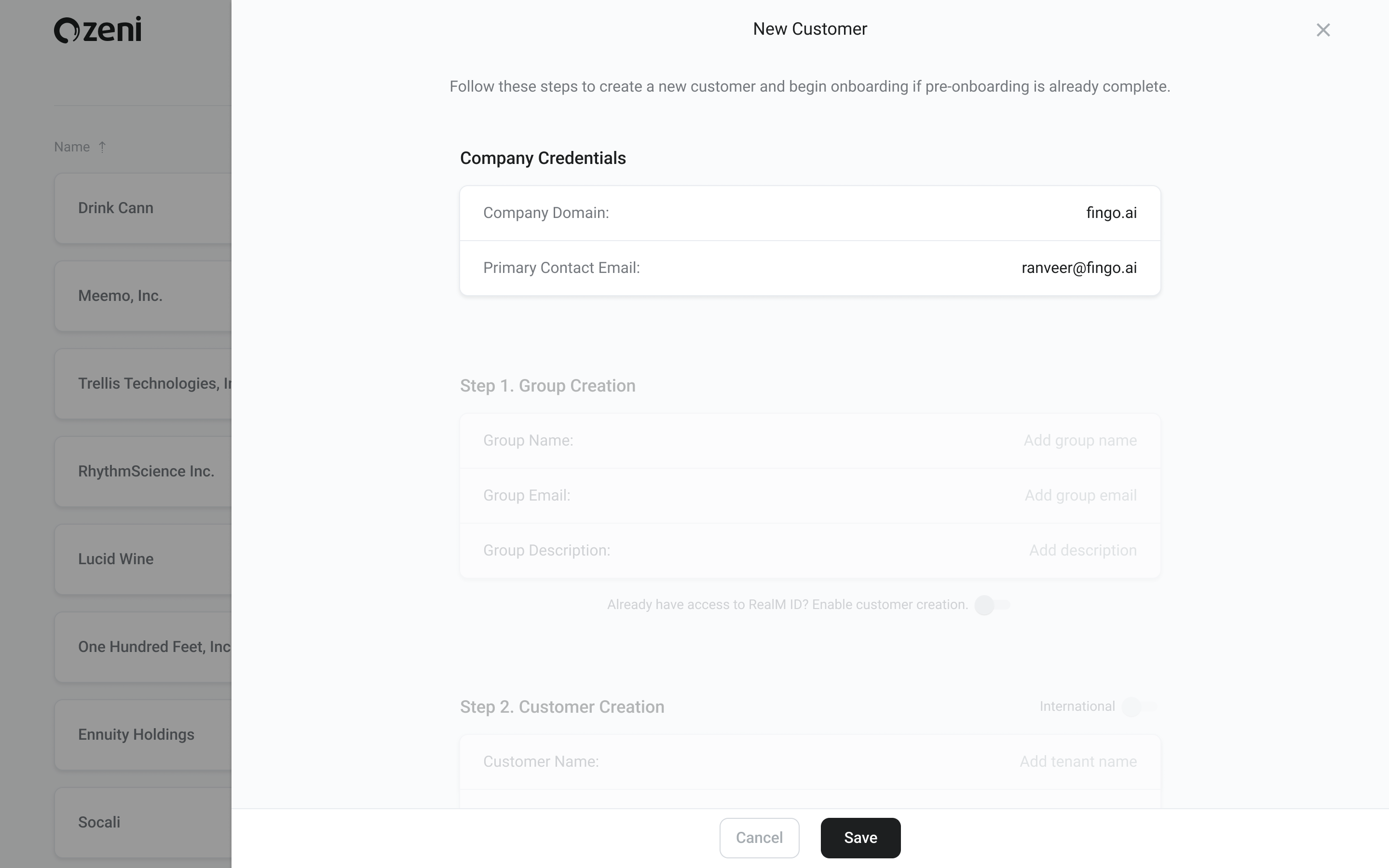
Before: Sales closed the deal, then onboarding spent around 65 days chasing access, credentials, calls, and cleaned data before customers saw a dashboard.
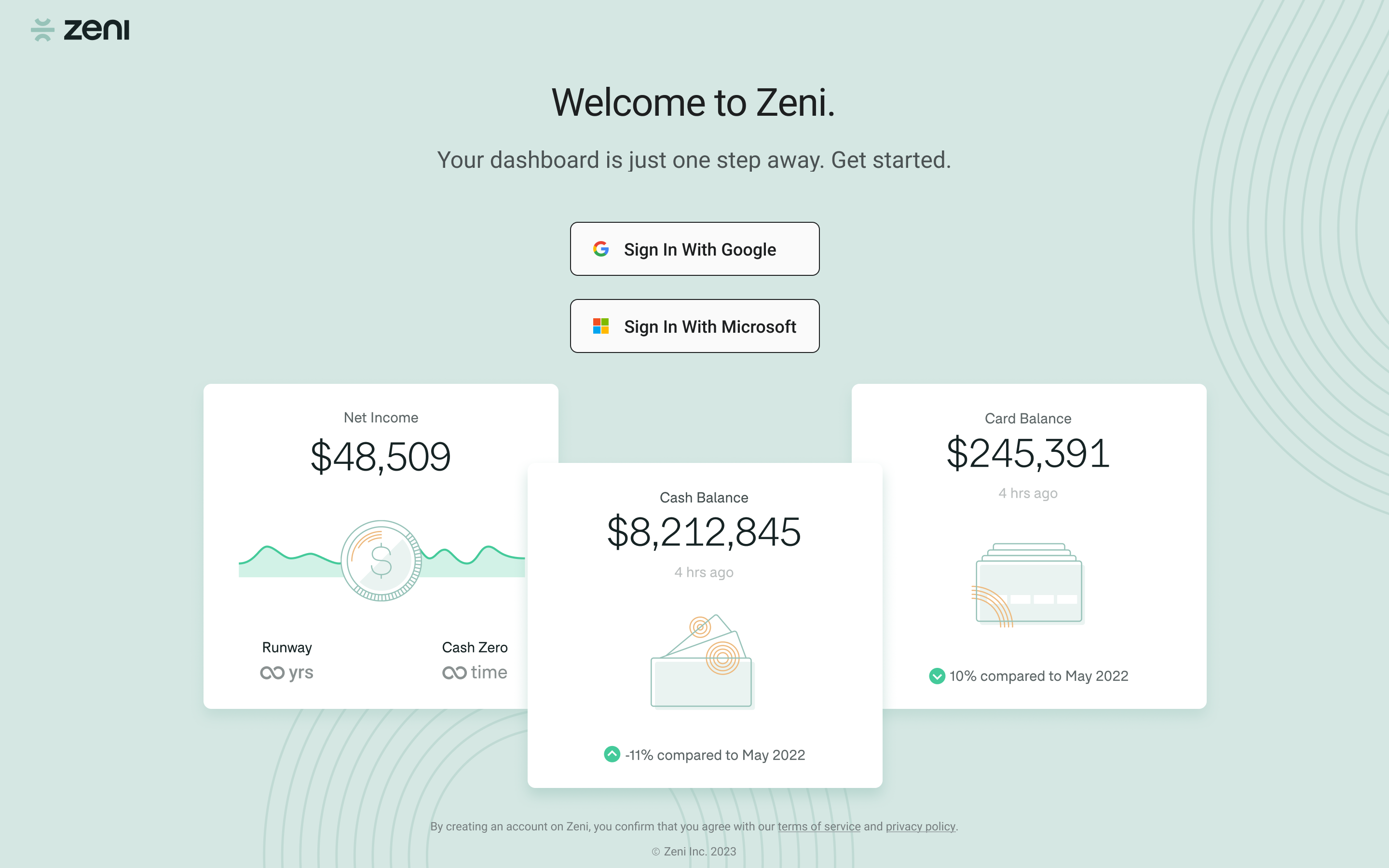
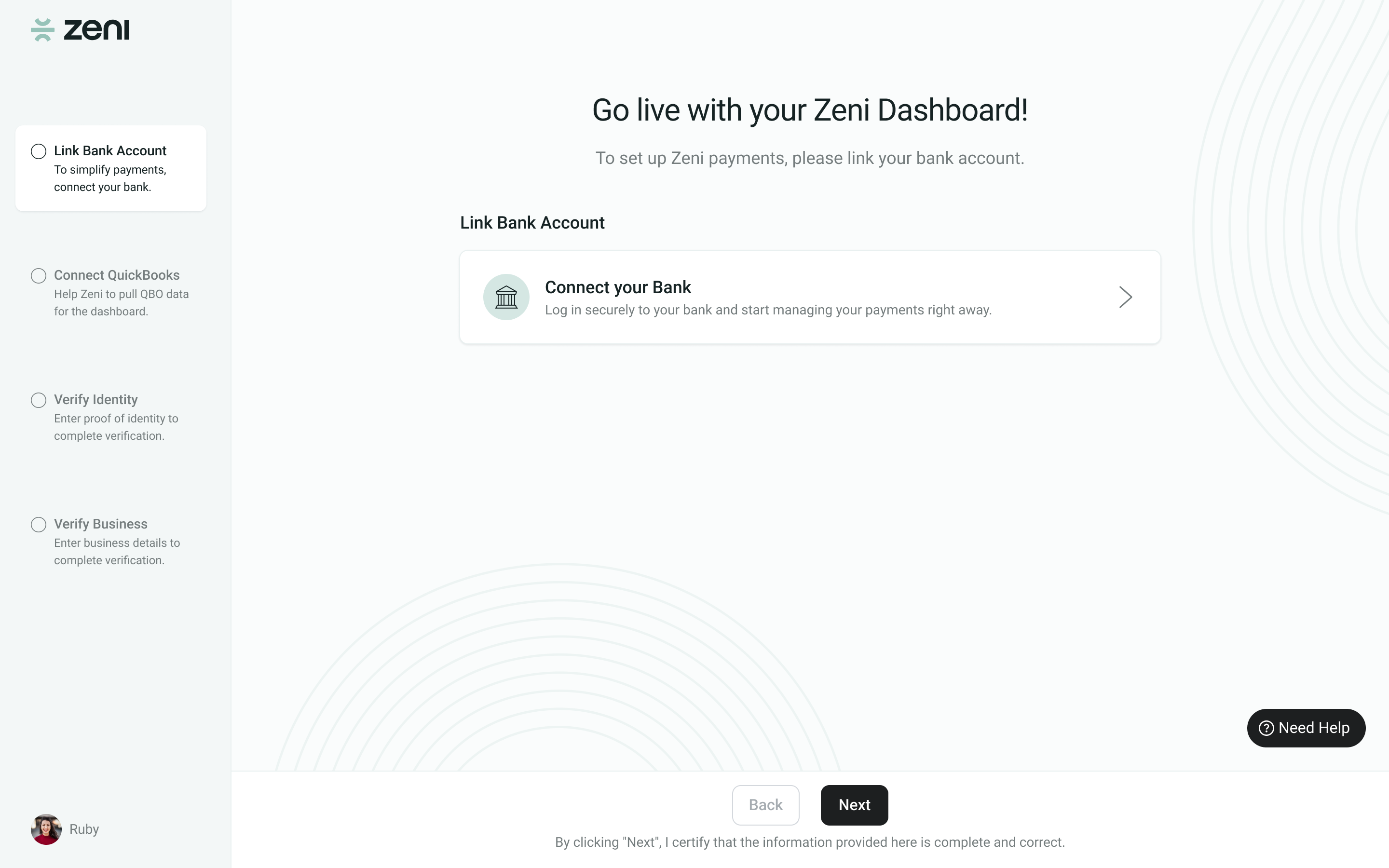
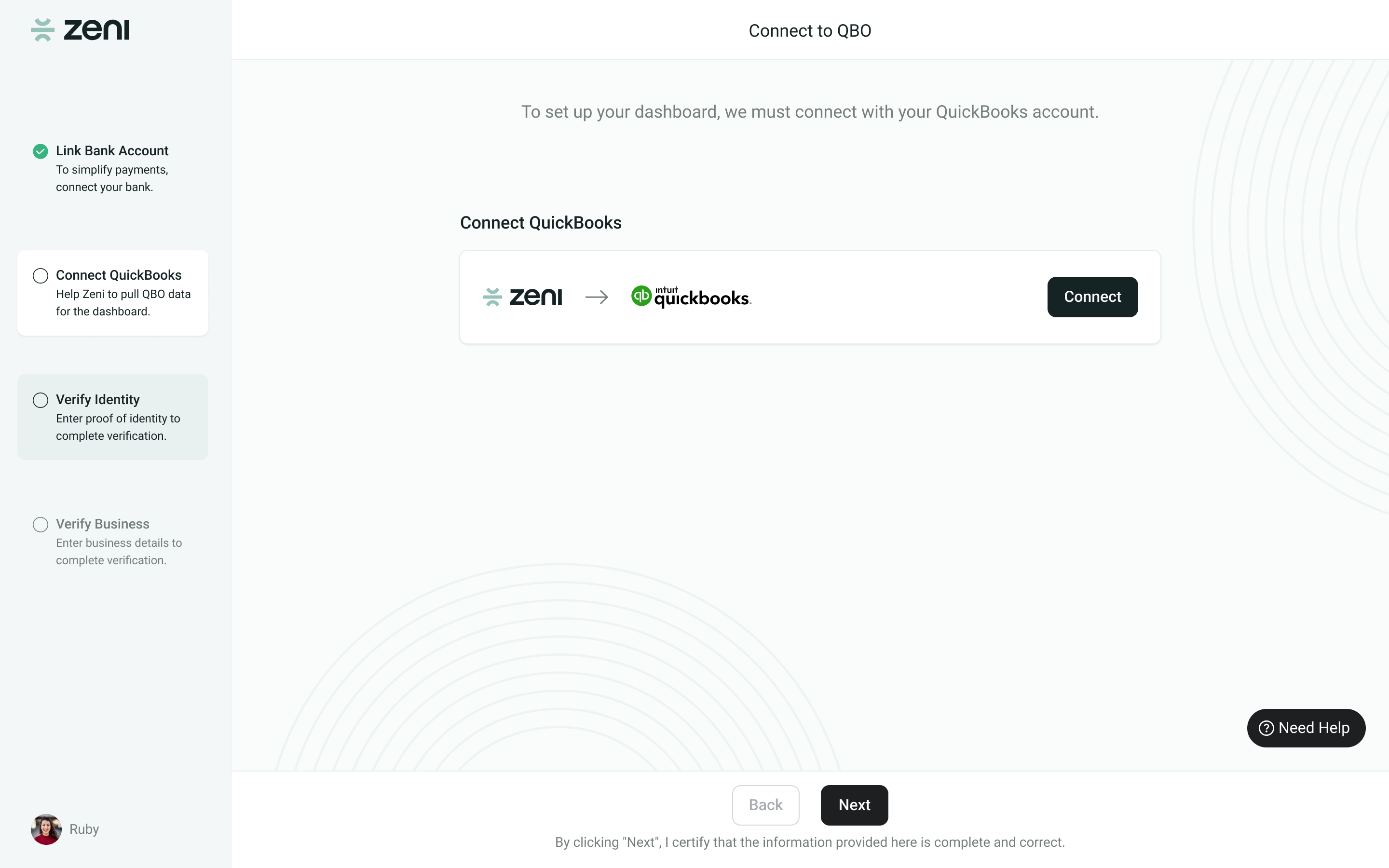
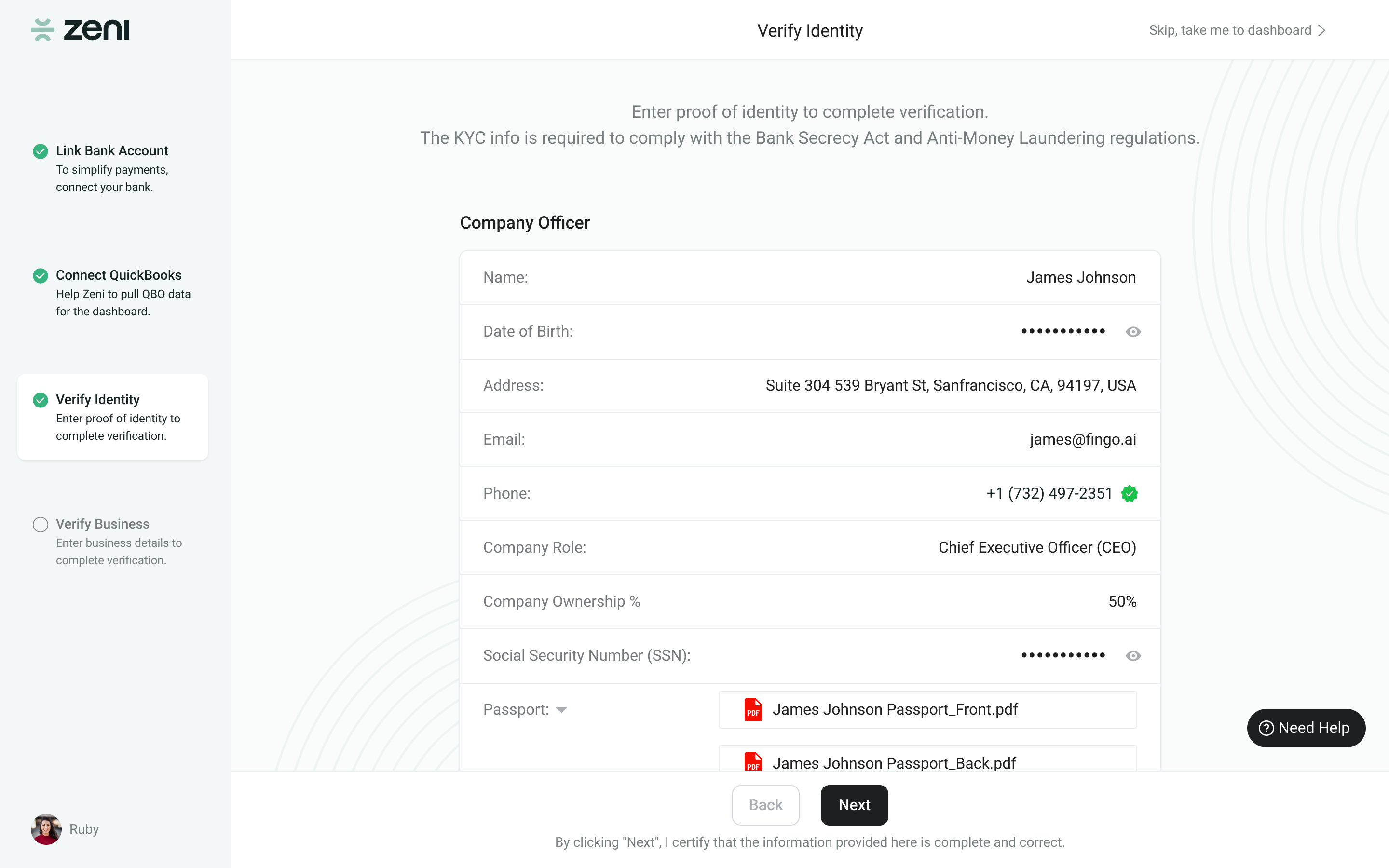
After: Eligible customers connected billing, bank, QuickBooks, company details, and officer information in one self-serve flow, reaching dashboard access in around 20 minutes.
My role
I owned the product framing, journey mapping, stakeholder alignment, and end-to-end UX direction. I led a 2-person design pod, delegated detailed flow exploration, and partnered with PM, engineering, onboarding, and FinOps to ship the assisted and self-serve tracks incrementally.
The brief I was given
“Add QuickBooks and bank-account connection links to the onboarding team’s internal tool, so reps can send tracked links to customers over multiple days.”
It was a tooling request. I treated it as one for about a week.
The brief I gave myself
Once I started mapping the existing flow with the onboarding team, the real picture emerged. Closing a deal did not mean activating a customer. After sales handed off, a dedicated onboarding team spent an average of 65 days getting a single customer to a working dashboard:
- Founders rarely had the information we needed: Realm IDs, QuickBooks access, bank details, and often did not know how to get it.
- Calls were booked, rescheduled, and re-rescheduled. Bank-connection links expired between calls.
- Customers entered the same bank details twice: once in Chargebee for billing, again in Zeni for operations.
- Even after onboarding finished, customers could not see their dashboard. Their account moved to FinOps, which cleaned and reformatted QuickBooks data so our ML models could work on it.
- No revenue was recognized until the entire chain completed. Drop-off inside onboarding was pure loss.
Adding two links to an internal tool would have made a broken process slightly more efficient. I wrote a different brief.
The bet, and how I made it
I proposed a north star most people in the room thought was unrealistic: a founder discovers Zeni, picks a plan, clicks Get started, onboards themselves, and uses the product with no sales call and no onboarding team in between.
The first reaction was skepticism. The idea sounded too far from how Zeni sold and onboarded customers at the time.
What got me past the skepticism was not a pitch. It was an artifact. I built two parallel maps:
- An assisted flow: the tooling request, fully solved. Real work, ready to ship.
- A self-serve flow: the future state, end-to-end, with every integration, every removed step, and every team impact called out.
The two-flow approach did three things at once. It gave the onboarding team the immediate fix they needed. It gave leadership a concrete future to react to instead of an abstract idea. And it lowered the political cost of betting on self-serve, because no one had to choose. We were shipping both.
The co-founder backed the bigger bet on one condition: ship it in pieces, watch what customers actually did, and let the data settle the argument.
What I designed, and what I removed
Removed information-gathering. Plaid handled bank connection in one click, without manual account numbers or link expiry. QuickBooks OAuth removed the Realm ID hunt, screen-shares, and email follow-ups. Company officers and company details were collected inline in the same flow.
Removed the handoff for customers who did not need it. Self-serve eligible customers had clean books and a common startup finance stack. They did not need a sales call, onboarding rep, or FinOps queue before seeing value. The system decided who qualified; humans only saw the customers who actually needed them.
Designed the two flows as one experience. The assisted and self-serve flows were not separate products. At any point in the assisted flow, an onboarding rep could hand a customer over to self-serve and the customer would not feel the switch. That meant we could move people to self-serve as they got comfortable, instead of locking them into the path they started on.
Designed for the team, not just the customer. The onboarding function did not disappear. It shrank, and the people who remained got to do meaningful work on genuinely complex customers instead of chasing email replies and rescheduling calls. I designed the internal review tooling alongside the customer flow so the change felt like a promotion of the team’s work, not a threat to it.
How I led the work
The initiative spanned Sales through FinOps, which meant I had to lead in the org as much as on the canvas.
I assigned the work and held the frame. I delegated the build across the pod and kept the strategic map and stakeholder alignment with me. That kept the team unblocked, and it kept me out of the details where I would have been a bottleneck.
Customer-first, even when it cost us a sprint. Zeni’s philosophy was that the customer experience came before the calendar. If a flow needed another round to be genuinely good, we took it. That principle ran through everything, including the work my team led on animations and small interaction details that made onboarding feel cared-for, not transactional.
Built alignment by making the future concrete. The self-serve map did not sit in my Figma. I used it in every cross-functional conversation until people from Sales, FinOps, and Engineering were using the same framing in their own meetings. That is the cheapest, surest form of alignment I know.
What changed
- Customer activation dropped from around 65 days to around 20 minutes for self-serve eligible customers.
- The onboarding function transformed from a chase-and-follow-up operation into a smaller team focused on real edge cases.
- Zeni’s go-to-market motion gained a self-serve channel that did not exist before, opening a customer segment the assisted motion could not economically serve.
- The business could begin realizing value earlier because activation no longer waited on weeks of manual work.
What I would do differently
Two things, both about zooming out.
Think longer than the sprint. It is easy to get pulled into design tasks and engineering tickets and lose the bigger view. The instinct I would build earlier is the one that asks, on every request: what does this mean for the customer and the business, not just the team’s backlog? The two-link tooling request was a one-sprint win. The self-serve channel was a quarters-long bet. Both shipped, but only one changed the company.
No small request is just small. I spent more time than I needed documenting a broken flow before I let myself propose replacing it. The size of the brief is not the size of the opportunity. Every request, however small, deserves a moment of zooming out to ask what it really means for the customer and the business. The faster you let yourself ask “what if this entire shape is wrong?”, the faster you get to work that matters.
